That One Time I Used Midjourney to Make a Lenormand Deck
So one time I used Midjourney to make a Lenormand deck. This is how and why I did it.

So one time I used Midjourney to make a Lenormand deck. This is how and why I did it.
For the casual reader there might be a couple things I need to explain before we get into the details. This explanation will also be mostly the why as well. I like to multitask.
Ok, so what is Midjourney and what is a Lenormand deck?
Lenormand is a system of cartomancy that uses 36 cards with fixed meanings for each card that are modified in part by relationships to the other cards in the spread. As with the tarot and many other decks used for cartomancy, it started out as a card game with playing card suits and numbers.
The deck is named after Marie Anne Adelaide Lenormand, who was a French occultist and cartomancer during the Napoleonic era. She was also an absolute badass and definitely a personal hero. However, there's no real evidence that she used this particular deck since her name was used on several decks.
Unfortunately, not a lot of her actual work survived her death. Her nephew inherited her work and, as a devout Christian, he burned every thing she wrote related to occultism. Because of course he did.
I think it's wonderful that despite that, her legacy has survived in the name.
Let's fast forward a couple hundred years to cover Midjourney. This may at first appear to be absolutely and incredibly unrelated to the Lenormand system (and occultism in general). However, buckle up because it totally does.
Midjourney is a generative artificial intelligence program that can generate images from natural language descriptions and receive feedback on those images to refine and update them. Blah blah blah. So in plain language, it's a bot that makes images from what you tell it to.
When you interact with an AI, it's hard to remember that all that capability for interaction comes from somewhere. That somewhere in this case is billions of images collected from the entire internet. They were gathered and fed into the woodchipper of this machine with absolutely zero regard for copyright. With this stolen art also came a lack of respect for any artist, whether they be affiliated with Universal Studios or my friends who sell their paintings online.
The program is morally absolute and utter trash. I may have an Opinion about this. Reuters reported that, in a copyright lawsuit against Midjourney, Universal Studios described it as a "bottomless pit of plagiarism". Correct!
So why in the hell did I use it for this project?
First, to make a couple things clear: I printed only eight copies of this deck and will never sell them. So no you can't have one. I will not profit off a program that has hurt my friends.
So, the purpose of this experiment was not to profit off of the product of stolen art. Instead I wanted to use it to witness something else: a visual representation of our collective unconscious.
If you're going to blame anyone for why I did this experiment, blame Carl Jung and his theory of the collective unconscious.
A brief TLDR of this theory is that we as humans have universal heritable elements that sit in our unconscious. We share them in ways that we don't quite understand. But they show up in how we view the world through a somewhat shared lens. This, for example, is where archetypes like the concept of a mother or freedom or justice live.
There is, of course, some debate about just how universal these things are, but the details of that are out of the scope of this discussion.
Basically it's the idea that all of our unconsciousness is collectively stuffed into our brains or souls or whatever.
So can we access this? Maybe. I like to think that that's what I use cartomancy for. Not to see the future or promise that we will meet a tall dark handsome man.
As someone who reads tarot as well, I use these decks as tools to access the parts of myself that I don't usually have access to. It's part meditation, part self therapy. Translating readings often makes me think about and process things I don't want to but need to.
It's fun!
Ok, to return to Midjourney. You may notice that I said they fed billions of images into this thing.
Those billions of images were created in some way shape or form by humans.
Art is how we express not only the world we see, but also our inner worlds.
So when giving it a prompt, I was asking Midjourney to distill the entirety of humanity's depiction of our inner worlds into a single image related to a single word. Rider, Fox, Coffin, Ring… etc. You get the idea.
Ironically, the command to do so was imagine.
This was the type of prompt I used to generate the images, only changing out the central elements with the fixed meanings of the Lenormand cards:
/imagine prompt:cyberpunk, burden, suffering, sacrifice, cross, incredibly detailed --ar 3:5
The first part is the command, prompt gave it the keywords to use and --ar 3:5 made sure I had the same aspect ratio for each card. I decided on a cyberpunk style to have a unified theme for the art and also because it felt delightfully ironic. The "incredibly detailed" part was just because I thought it was interesting to see how it would generate images with that prompt.
It returned cards that looked like this:
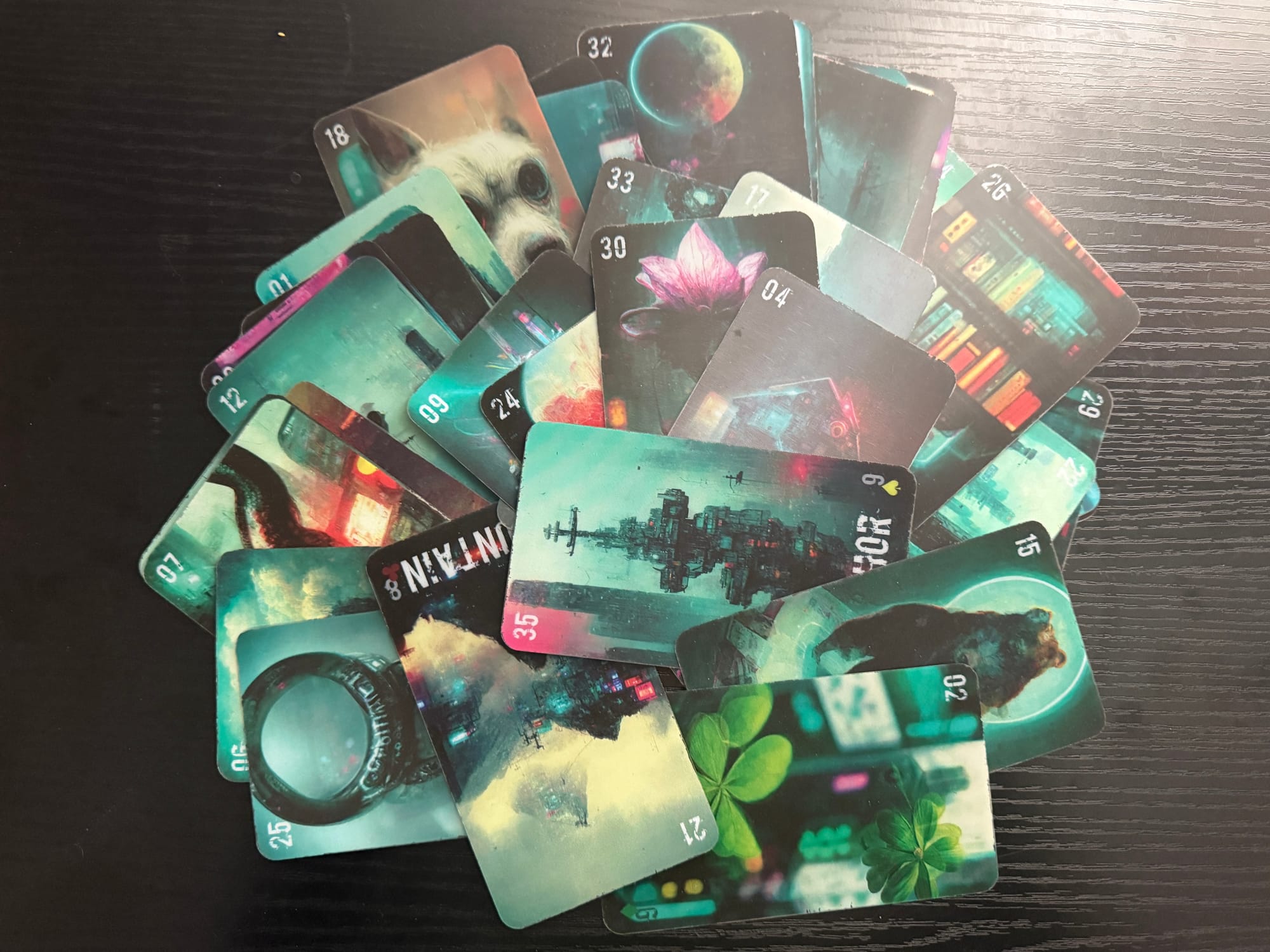
Notice that the art is very not particularly… human. Since I was using Midjourney Alpha V4, I was using it before it started being able to actually copy artists' styles perfectly. Instead of the uncanny valley of stolen styles, it would often return strange looking nonsense.
This strangeness was why I wanted to use it. If we were to glimpse the unconscious world, would it look like this? Who knows, maybe. I imagine it would definitely look strange but just so weirdly familiar to us.
It did feel a little like being able to peek under the bed to see what we dream together.
So was it a good experiment? Maybe! Good is relative. But it was definitely interesting.
And it makes a helluva good Lenormand deck.
(side note: the printing service I used has a print option to create lenticular cards, which is another reason I wanted to use Midjourney. The image generator would return four images based on your prompt. These were all vaguely similar but also different enough to be their own images. That similarity meant that I could save two images for each card and when printed, they would wiggle. I thought that was just fun.)